Backstage 1
John Goto:
There are two ways I'm thinking we could configure the characters:
1) As before with one figure outside a significant location (RBS bank, Stock Exchange etc).
2) All the figures arranged around a single location, for example the intersection at Mansion House Place and adjacent streets.
I would like to test out the possibility of the later as I think it will be a richer experience, and be a more interesting challenge for us. Do you think we should start with some local trials around UoD and/or my house to see how close figures can be put to each other, and what happens?
The other possibility is to create a game in which City participants annihilate the poor, blow them away. Have you had any thoughts on the zap idea?
Matthew Leach:
I like the idea of the characters being in the same area - more like a guerrilla gallery than a tour. If we want to place them in a circular arrangement then we'd need to pick a location where they can stand in the middle. Is that what you had in mind? We should definitely start running some tests.
From what I can see interactions can only be triggered by buttons (same as the play audio, fetch webpage ones we use already). It isn't quite as direct as zapping them, but it does mean that you could give people an option of what they want to do: help or 'clear-away'? Whatever seems appropriate.
Everyone that uses Layar has a unique id, so their past choices could be tracked. We could try and build in a cumulative effect of people's choices - but that's something to consider at a later date.
Regarding the enlarged information panel - I'm not sure if the options were there when I last checked, but two new settings have been added to version 4. One option lets you decide if the information appears at all (showSmallBiw), and another controls if an information panel appears when the user clicks on the figure (showBiwOnClick). Both can be set per hotspot. We'll have to give them a try.
John Goto:
I was talking to a surveyor today at UoD Research Day. You probably know all this but the limitation we are up against is that iPhones use L1 system for GPS tracking. L2 costs 2k per device but is a lot more accurate down to mm with L3. So with ten metres latitude the figures would need theoretically to be 20 apart to be sure of no overlap. As we have discovered atmospherics also play a part, as does how long you wait for the reading to settle.
But trying variants out as we planned seems best way forward.
Matthew Leach:
I'll admit that I don't know a great deal about the technical side, and some brief research didn't turn up much either. I suspect the extra 2k is added on to the unit price of survey equipment, which might be £15k to begin with. The signal is already being beamed down, so the cost is just the receiving equipment. I think the main restriction in mobile devices is the tiny antennae - I'm not sure if they could pick up the L2 band or not.
The accuracy will affect how close we place things, but I don't think it is a limiting factor itself. It works a bit like layers in Photoshop - the bottom layer being reality, and a single layer above containing all Layar points. Accuracy will move around the top layer, but all points on that layer move together. Two points that should be 5cm apart will stay 5cm apart, even if they're both 20m away from where they should be.
I did some experimenting today. I added a button that passed information to a database and counted how many times you clicked on it - similar to the ghost hunting one. It works ok, but needs a little more thinking. I had a look at a Layar server (http://code.google.com/p/porpoise/), although it might not be appropriate, and also tried to make a start on my own - but hit a few walls. On the bright side I got a better understanding of Layar.
I'll try to add some points around your house (using the old system) tomorrow, to try out the spacing.
John Goto:
Here are some screen grabs of the tests outside my house – they look promising.

Tests 1 & 2. Scale is fine. They have the familiar problem of floating, despite having calibrated horizon - but I can live with this.
I need to tweak the contrast. The overlapping figures would work well here perspectively if reversed, but there are no signs of the two figures merging.
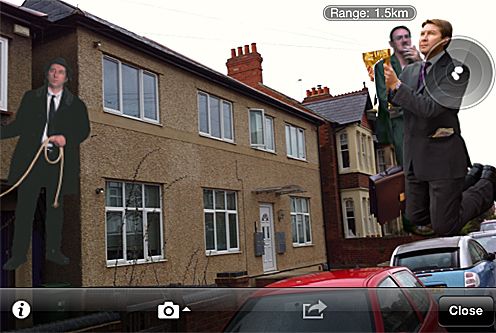
Beginnings of a configuration. Notice the two overlapping figures are now in the right order but the shoulder is eating into the cup.

When I tapped the figure the caption appeared OK - but what a caption! Layar do need to sort this, too chunky by far. Maybe if it's going to stay this way we can do more with it graphically?
on Apr 11, 2011 Posted by: johngoto in AR Gilt City
The Apparatus of Photography
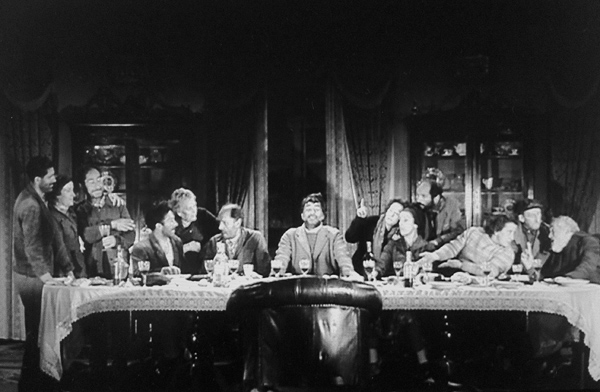
Until yesterday evening I hadn’t seen Luis Bunuel’s ‘Viridiana’ since I was a student. It still looks great and I admire his fearless attack on the Church and State in this, his first film after the Franco government had invited him back from exile.
The narrative includes a group of outsiders who have been adopted by an ex-nun. They are rightfully ungrateful of her pious charity and take advantage of the absence of the landowner and his family to have a riotous beggars’ banquet.
Bunuel’s parody of Leonardo’s ‘Last Supper,’ enacted during the banqueting scene, I remembered well. But I had forgotten the context, which amplifies his ‘blasphemous’ intent (as the Vatican described it) by reference to the apparatus of photography.
Enedina volunteers to take a photograph of the occasion as a souvenir. ‘But where’s your camera?’ ask the fellow beggars. ‘My parents gave me one’ she replies. The tramps proceed to arrange themselves into the famous tableaux. ‘Stay still, hold it,’ she commands, and then makes the exposure - by suddenly hoisting her skirts!

on Apr 10, 2011 Posted by: johngoto in AR Gilt City
Calm in the City
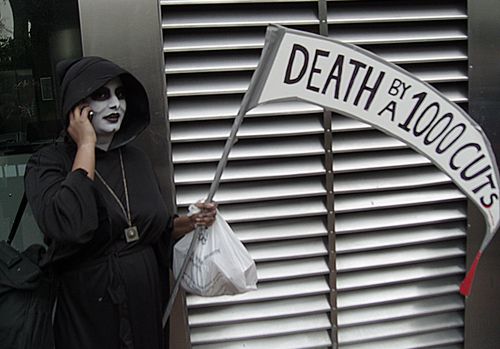
Mervyn King, governor of the Bank of England, said that those bankrupted and made unemployed by the banking crisis had every reason to be resentful and protest.
“The price of the financial crisis is being borne by people who absolutely did not cause it,” he told the Treasury select committee, ”Now is the period when the cost is being paid. I’m surprised that the degree of public anger has not been greater than it is” (Guardian: 2/03/2011).

I broke away from the huge TUC ‘March for the Alternative’, bought a couple of reggae CDs in Soho and headed over to the City for a look around. Being a Saturday the place was absolutely deserted. Two miles away 400,000 people were protesting about deep government cuts to public services, but in the Square Mile all was calm.
on Apr 05, 2011 Posted by: johngoto in AR Gilt City
Shifting ground
A common principle in web 2.0 technologies is that they are 'permanently in Beta' - essentially never reaching a state where they're finished, and undergoing constant development. The Layar platform that Gilt City is built upon demonstrates this well, having gone through several major changes in the few short years since its launch. Adjusting to these constant changes is a challenge that anyone using Web 2.0 technologies has to accept; and quietly hopes that the major feature that they rely on isn't broken in the next release.
A recent change is forcing us to rethink some parts of the project. The consolation is that it is at the beginning, rather than near the end.
on Apr 02, 2011 Posted by: matthewleach in AR Gilt City
Bang!
Bang! And they are off … like in the days of the Gold Rush.
On ‘Big Bang Day’ in 1986 the UK financial markets were deregulated. The free market doctrine of unfettered competition was a central tenet of Thatcher’s reform programme. At first it seemed to work and an economic boom followed creating tremendous wealth for many working within the City of London, which itself began to expand into a new development at Canary Wharf.
John Lanchester identifies the failure of regulation as one of the main factors that caused the banking crisis of 2008. To this he adds a climate of post Cold War triumphalism regarding the victory of capitalism: the sub-prime market: and the failure of the mathematical models used to predict risk (Whoops! By John Lanchester, pub Penguin, 2010).

Dealer from Gilt City 2002/4
on Apr 02, 2011 Posted by: johngoto in AR Gilt City
AR Gilt City; our intension
John Goto & Matthew Leach
The financial crisis of 2008, and its aftermath, is the subject of this collaborative project. Using Augmented Reality technology, the aim is to populate the streets of the City of London with an assorted cast of significant outsiders.

John Goto made his first version of Gilt City between 2002/4. Using photo digital montaging techniques, he explored the widening gap between the rich and poor through a series of prints showing marginal characters isolated in the bustling commercial centre. These prescient figures will now return to haunt the disgraced Square Mile.
Augmented Reality is achieved by combining four functions of a smart phone: GPS reading, compass, camera and internet connection; to create an image layer in front of the every day scene observed through the camera. The specific image that appears is triggered by the location. Additional information is supplied through text panels, sound samples and maps.
This new method for exhibiting the series builds upon the success of two previous projects - recognition of which led the company behind the augmented reality platform, to invite the creators to join their 'Pioneer' programme.
on Mar 29, 2011 Posted by: admin in AR Gilt City
« Prev 1 2 3 4 5 AR Gilt City final »