AR video by the Royal Exchange
on May 23, 2011 Posted by: johngoto in AR Gilt City |
Augmented Reality meets Living Sculptures
Sometimes you get lucky. I’d been weighting up whether or not to go to the City on Saturday to check out some recent adjustments Matthew had made to our AR project. Logic told me to wait until a weekday when the streets would be full of office workers that I could incorporate into the installation shots. As logic is no friend of art I went anyway, and here is what I found.
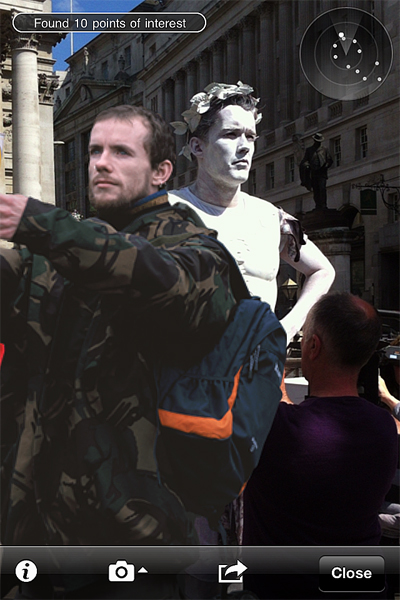
A film crew of about twenty, with all the gear, was shooting three actors against the façade of the Royal Exchange. Looking like living sculptures dressed in classical robes, the actors were perched on boxes covered in white cloth. The crew also looked the part, playing their allotted roles.
At best the setup might have referred to Godard’s classical statues in Le Mépris, or Baptiste’s serenade of Garance in Les Enfant du Paradis - but I had my doubts!
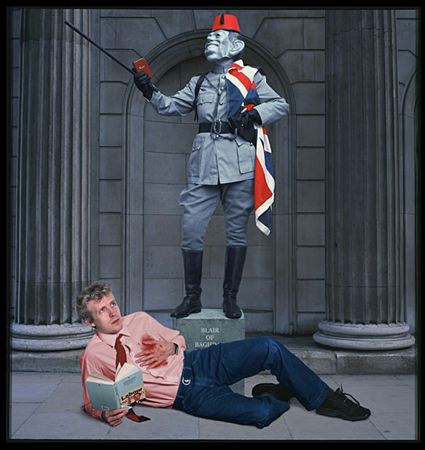
Living Sculpture from Gilt City 2002/3
Anyway, I’ve been interested in living statues for a while and in fact incorporated the one above in the original version of Gilt City. I was once even invited to be a judge at the World Living Statues Award in Arnhem, Netherlands!
Avatars; Living Statues; City Workers; Augmented Figures; you get the picture. I also shot some video, which I’ll post when edited.
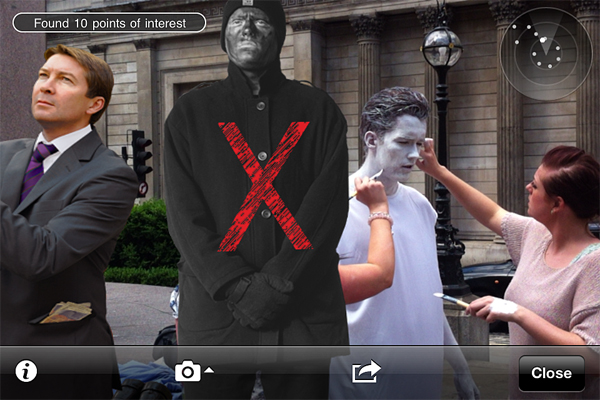
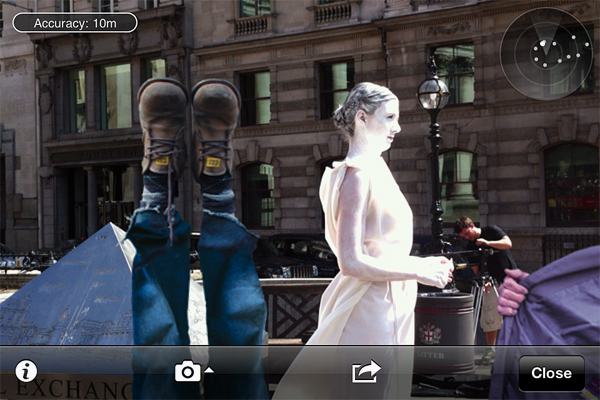
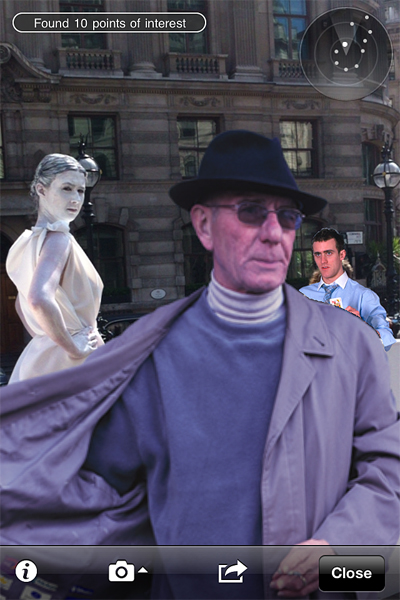
on May 22, 2011 Posted by: johngoto in AR Gilt City
Alone Together Two
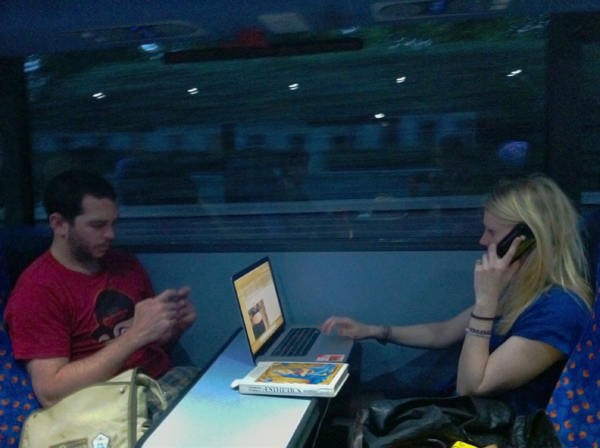
I made this after reading recent posts by Shuka Glotman and Gudrun Bielz.
Actually, I love having information at my fingertips; I’m addicted to it! I grew up in an informational desert and have spent much of my adult life trying to fill in the gaps.
Yesterday I was reading Lloyd Bradley’s excellent book on Jamaican music, ‘Bass Culture’. The question I’ve been asking myself for some time is how you get from Mento and the influence of American R&B, to Ska? The acquisition of Trojan’s box set ‘Jamaican R&B’ went some way to answering this as you can hear that shift to the off beat, but Bradley takes you through it one rare recording after another. From ‘Manny Oh’ through ‘Easy Snappin’’, ‘Boogie in My Bones’ and ‘Pink Lane Shuffle’ to the seminal ‘Oh Carolina’ – and all of it is readily available on YouTube. It made for a great afternoon!
on May 22, 2011 Posted by: johngoto in AR Gilt City
Beggars Belief
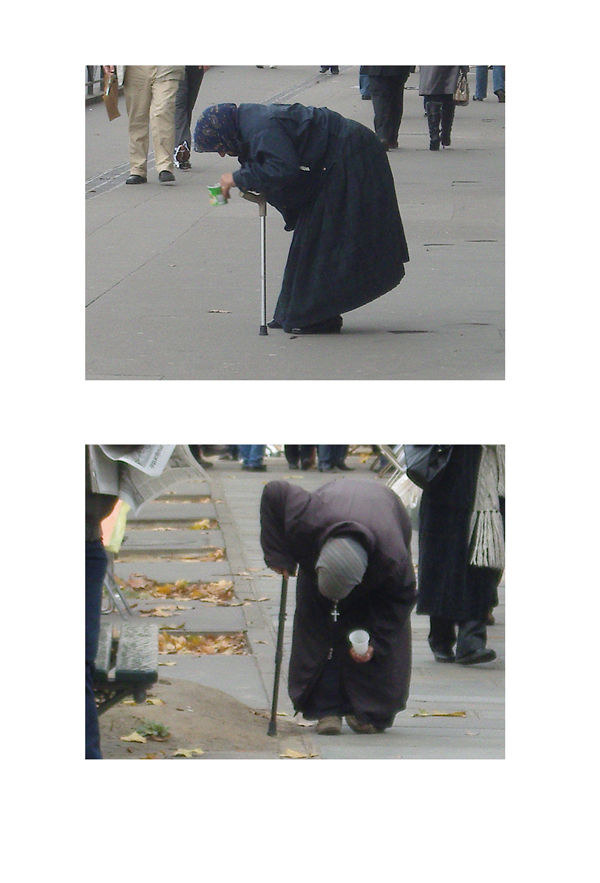
In a Parisian street I was moved by the sight of a beggar bent double by her arthritic condition. I became suspicious, however, when five minutes later I saw a second beggar improbably displaying the same condition. I started to figure out the rhetoric of the pose. They must be young fit women to hold this position, even with the help of the crutch and whatever supports were hidden beneath their baggy clothing. The headscarves concealed their age, and a crucifix confirmed the piety of the pose. Or was I shamefully wrong?
 on May 20, 2011 Posted by: johngoto in AR Gilt City
AR-Politics
There are a number of artists using AR to make political and social comment. This morning John-Mark Ikeda sent me a link to a new piece he has created which also deals with the Banking Crisis.
FREE FALL is a multi-site installation art piece using Augmented Reality. It is currently installed at the bank headquarters of the top ten recipients of TARP funds.
Other political AR projects I’ve recently come across include -
An artwork by Tamiko Thiel commemorating the ‘Carnation Revolution’ which broke out in Largo do Carmo (Carmo Square) in Lisbon, Portugal, on April 25th, 1974.
http://www.youtube.com/watch?v=VxBEr_bq_0k
Mark Skwarek’s ‘Liberty to Libya’ project, showing an augmented reality dove which is presently circling the city of Tripoli, Libya.
http://libertytolibya.wordpress.com/
John Craig Freeman’s (of 4Gentlemen) Tiananmen Square AR project commemorates 'Tank Man' and the erecting of the 'Statue of Democracy' by the Chinese student movement in 1989.
http://fourgentlemen.blogspot.com/2011/01/tiananmen-square-augmented-reality.html
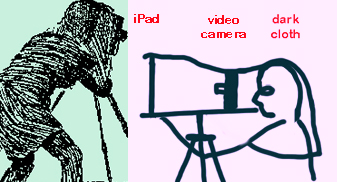
My approach to recording our AR installations has been as a photographer, awaiting a significant coincidence of actual event before the lens, with the augmented onscreen image.
To use video is more of a problem as the Layar App doesn’t have a video capture facility, so it’s a matter of using a second camera to shoot the onscreen events. Surface reflections can distract from the image. I offer a solution here using a kind of monorail and dark cloth, like in the good-old-days!
on May 17, 2011 Posted by: johngoto in AR Gilt City
The Fundamental Challenge for AR
In a previous post I mentioned that there were fundamental challenges that could delay AR's mainstream adoption. The main challange that has existied since the very beginning is termed 'Registration' - the alignment of the real and the virtual.
Although it isn't limited to computer systems. Consider Pepper's Ghost, which John introduced in an earlier post (http://www2.derby.ac.uk/dmarc/digital-hybridity/augmented-reality-some-precedents.html). Neither the on-stage actor nor the ghost can see each other. They must act to empty space. Only the audience sees the combined effect. Here the solution is meticulous rehearsal, and the marking of points on the floor.
In computer-based augmented reality the observer takes the place of the audience, and the computer takes the place of the ghost. Hidden in the dark, 'under the stage', the computer has two main ways of gaining information about the outside world.
Optical Tracking
The computer examines the video feed and looks for patterns that it recognises. This is the main system that the Nintendo 3DS uses. It's cheap and accurate, but has a limited field of view. The further the object is from the camera, the larger it has to be, and anything occluding the object breaks the tracking.

The image above shows an early example of optical tracking (Mohring et. al., 2004). Modern systems can identify images (such as DVD covers), but the processing required is similar
Sensor Tracking
This has the most variety in techniques, mainly because the best solution has yet to be found. Smart-phones use GPS positioning to identify their location, and digital compases to identify their orientation. With this information they move and rotate their internal virtual world to align with the real world around them. However, GPS doesn't work indoors (or particularly well in heavily built-up areas). There are highly accurate sensor systems that can be used indoors, but they are expensive and have limited range.
The original optimism for AR has been tempered somewhat, but there are still plenty of opportunities to work within the limits of the technology.
on May 15, 2011 Posted by: matthewleach in AR Gilt City